American travelers who have visited Europe in the past five years or plan to within three years say the trip itself is close to untouchable. In a new survey of 1,000 U.S. adults in that group, 77% said they would carry debt or a credit card balance to take a trip they considered once-in-a-lifetime, and 1 in 4 would carry $3,000 or more.
Asked what they would cut if they had to trim the trip budget by 20%, respondents reached for economy seats, cheaper hotels, and cheaper meals. Fewer than 1 in 5 would shorten the trip, and just 6% said they would rather delay it than cut back on spending at home.
Jump to a section of this article
77% of Would-Be Europe Travelers Would Carry Debt for a Once-in-a-Lifetime Trip
Key Findings
- 77% of travelers surveyed said they would carry debt or a card balance for a once-in-a-lifetime Europe trip; 25% would carry $3,000 or more.
- Just 6% would rather delay the trip than cut back on nonessential spending at home.
- To absorb a 20% budget cut, 46% would travel off-season and 43% would fly economy, while only 19% would shorten the trip.
- If flights ran $500 more per person than expected, just 11% would postpone or cancel.
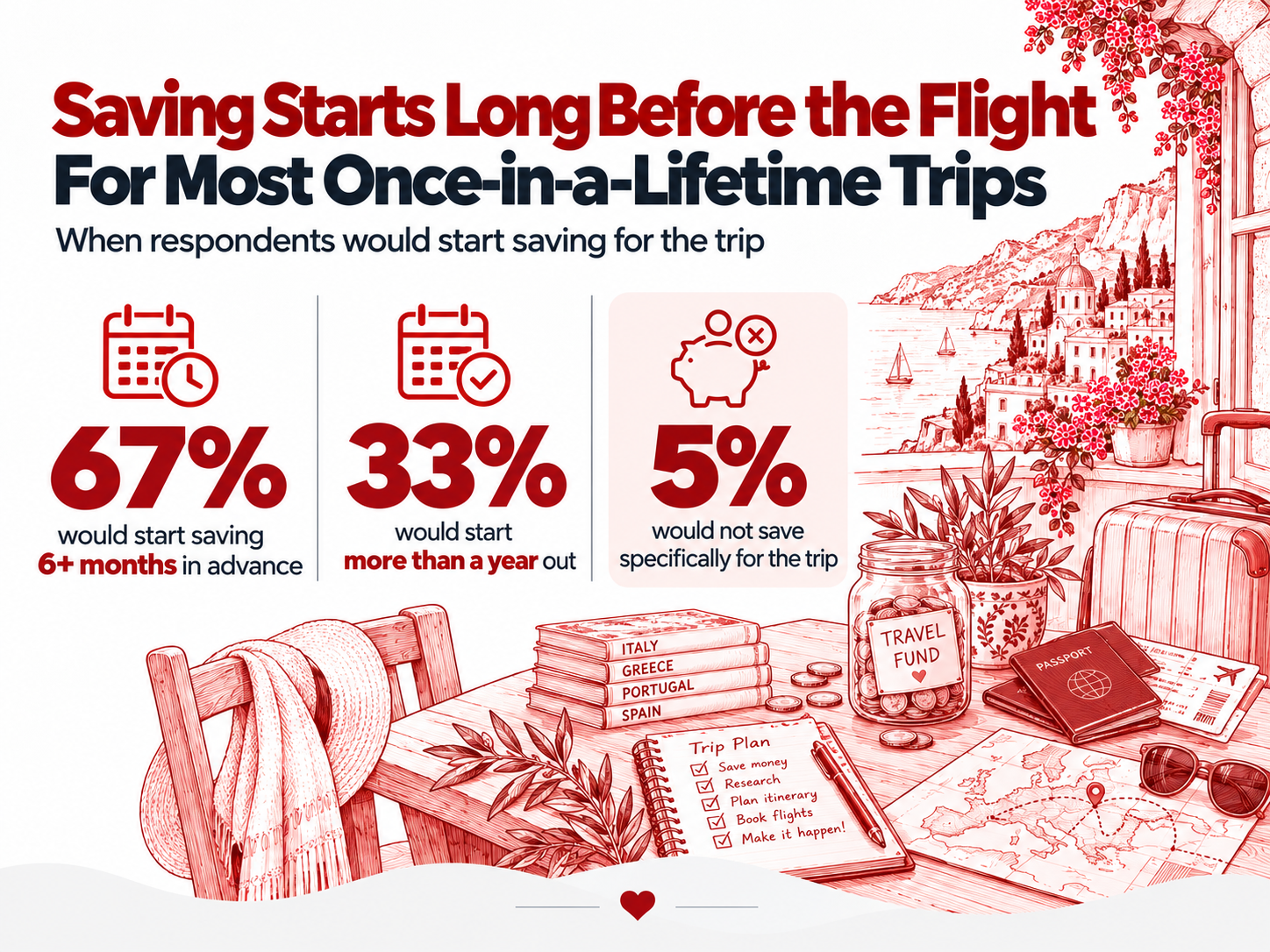
- 67% said they would start saving six months or more before the trip; 33% would start more than a year out.
- Parents of children under 18 were more willing to carry once-in-a-lifetime trip debt than travelers with no children at home, 84% to 72%.
- 67% would pay a premium for a custom-planned trip, and 42% would pay 6% or more on top of the trip cost.
The Home Budget Bends First
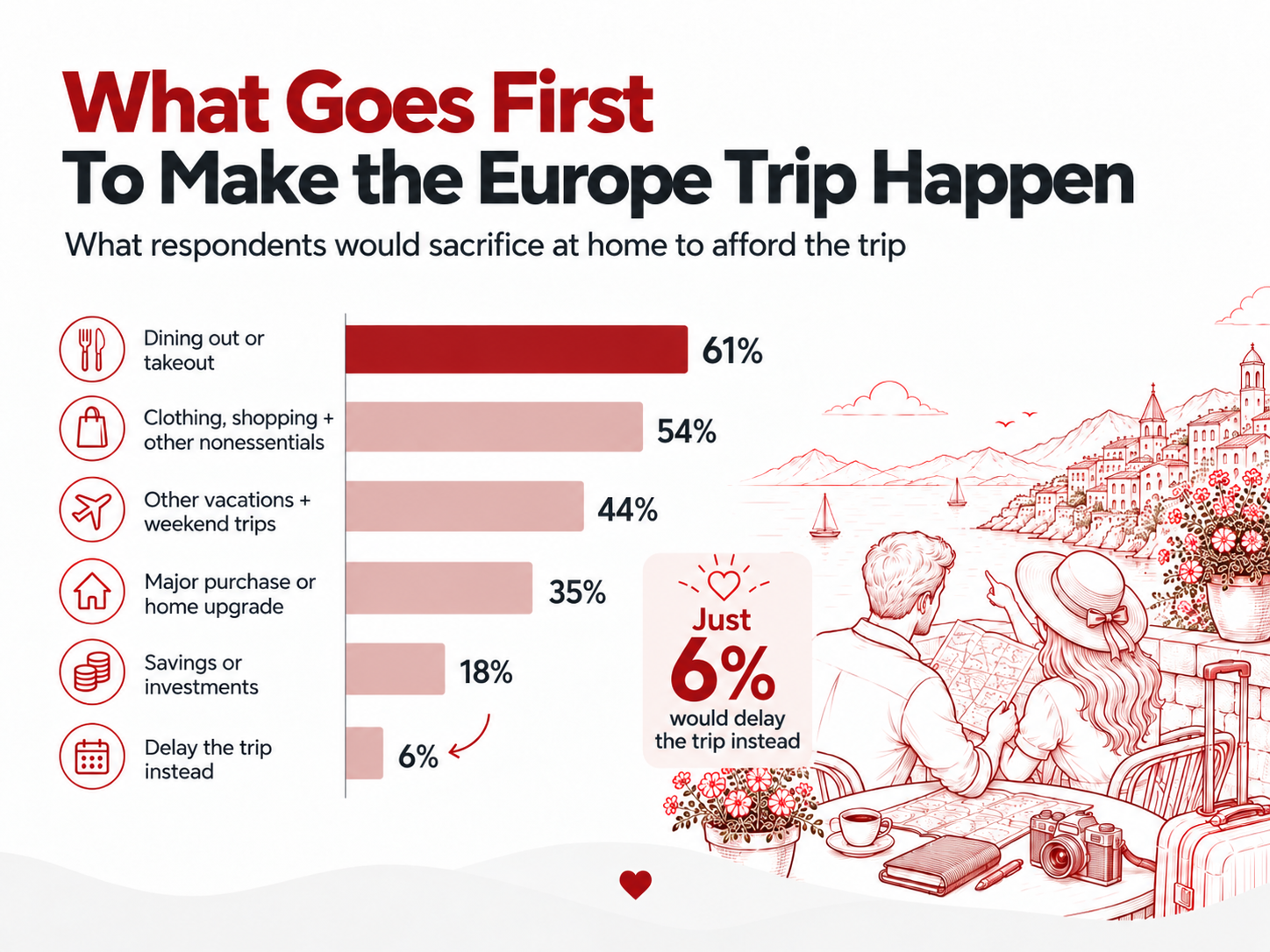
Before the trip budget ever takes a hit, the household budget does. Asked what they would sacrifice at home to make the trip possible, respondents could select more than one answer and chose about two and a half on average.
- 61% said they would give up dining out or takeout for several months.
- 54% would cut clothing, shopping and other nonessential purchases.
- 44% would skip other vacations and weekend trips that year.
- 35% would put off a major purchase or home upgrade.
Even the long game was on the table. 18% said they would pause contributions to savings or investments to get to Europe.
Then comes the reversal that frames the whole survey. Offered the option to simply delay the trip rather than cut back, just 6% took it. For nearly everyone else, the only question was what goes first.
A 20% Budget Cut Costs Comfort Before It Costs a Day
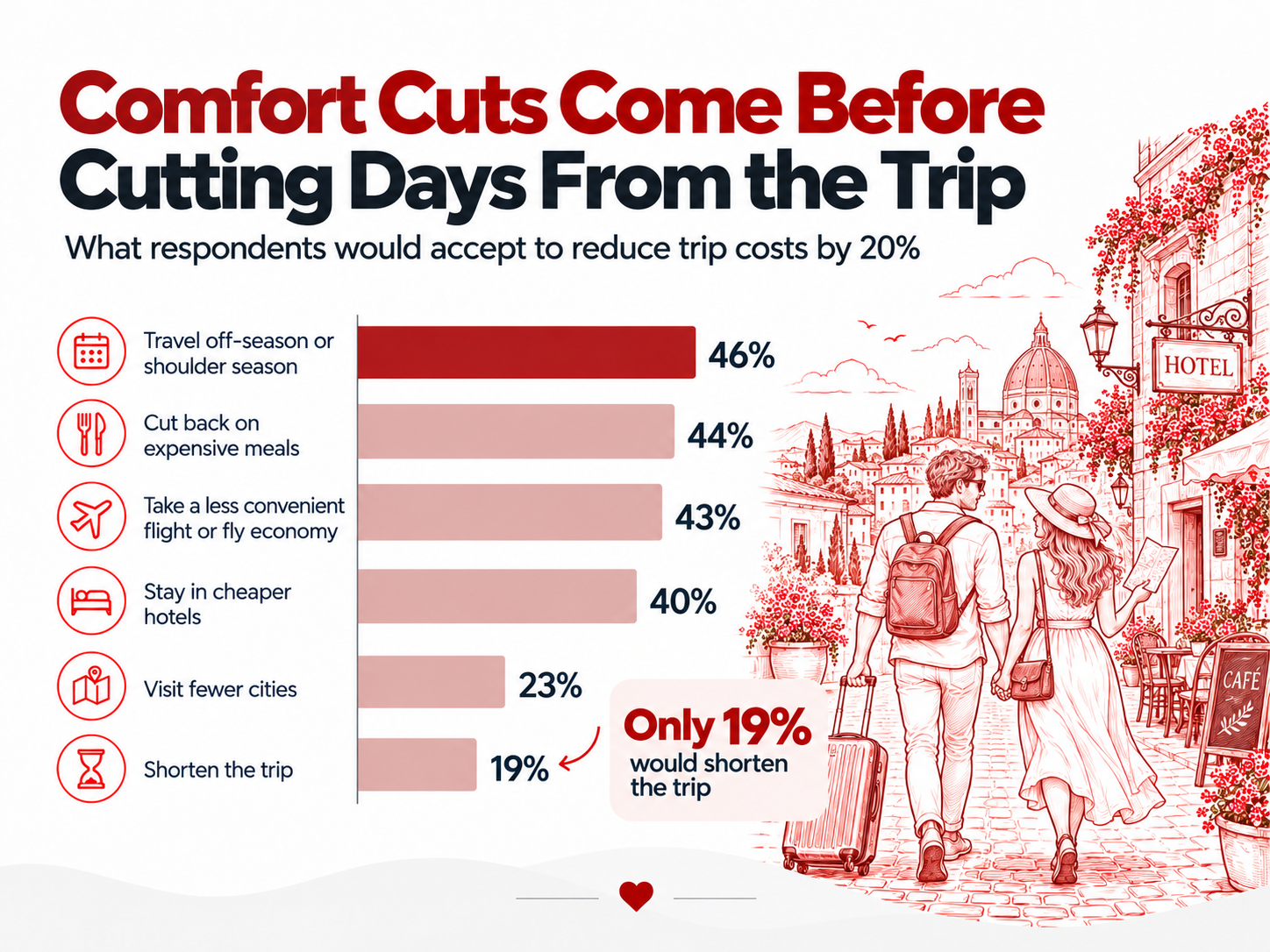
The same instinct shows up when the trip budget itself has to shrink. Asked what they would accept to cut trip costs by a fifth:
- 46% of respondents said they would travel during the off-season or shoulder season.
- 44% would cut back on expensive meals.
- 43% would take a less convenient flight or fly economy.
- 40% would stay in cheaper hotels.
Only 19% would shorten the trip, and 23% would visit fewer cities. Each of those comfort cuts drew more than twice the support of cutting days.
Nearly 80% Would Keep The Trip Intact Even With Higher Airfare
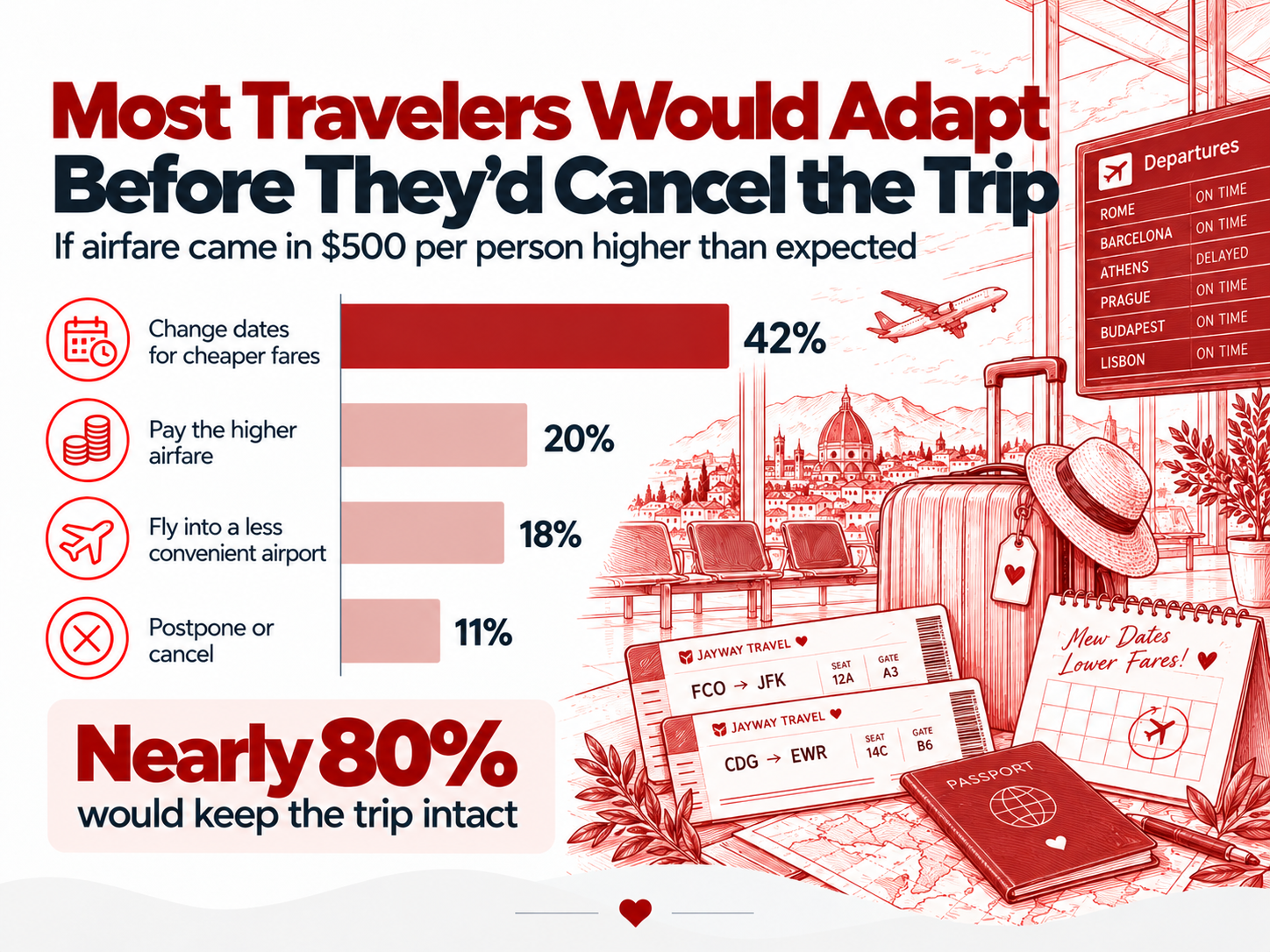
Price shocks get the same treatment. If airfare came in $500 per person higher than expected:
- 42% said they would change their dates to find cheaper fares.
- 18% would fly into a less convenient airport.
- 20% would simply pay up.
Just 11% said they would postpone or cancel. Combined, nearly 80% would find a way to keep the trip intact.
Experience seems to sharpen the trade-off. Among respondents who had already been to Europe in the past five years, only 3% said they would try to keep every spending category as cheap as possible, compared with 18% of those still in the planning stage.
Past travelers were also far more willing to spend extra on flights, 28% versus 13% of planners. People who have done the long-haul flight in a middle seat apparently remember it.
The Debt Line Runs Through The Household
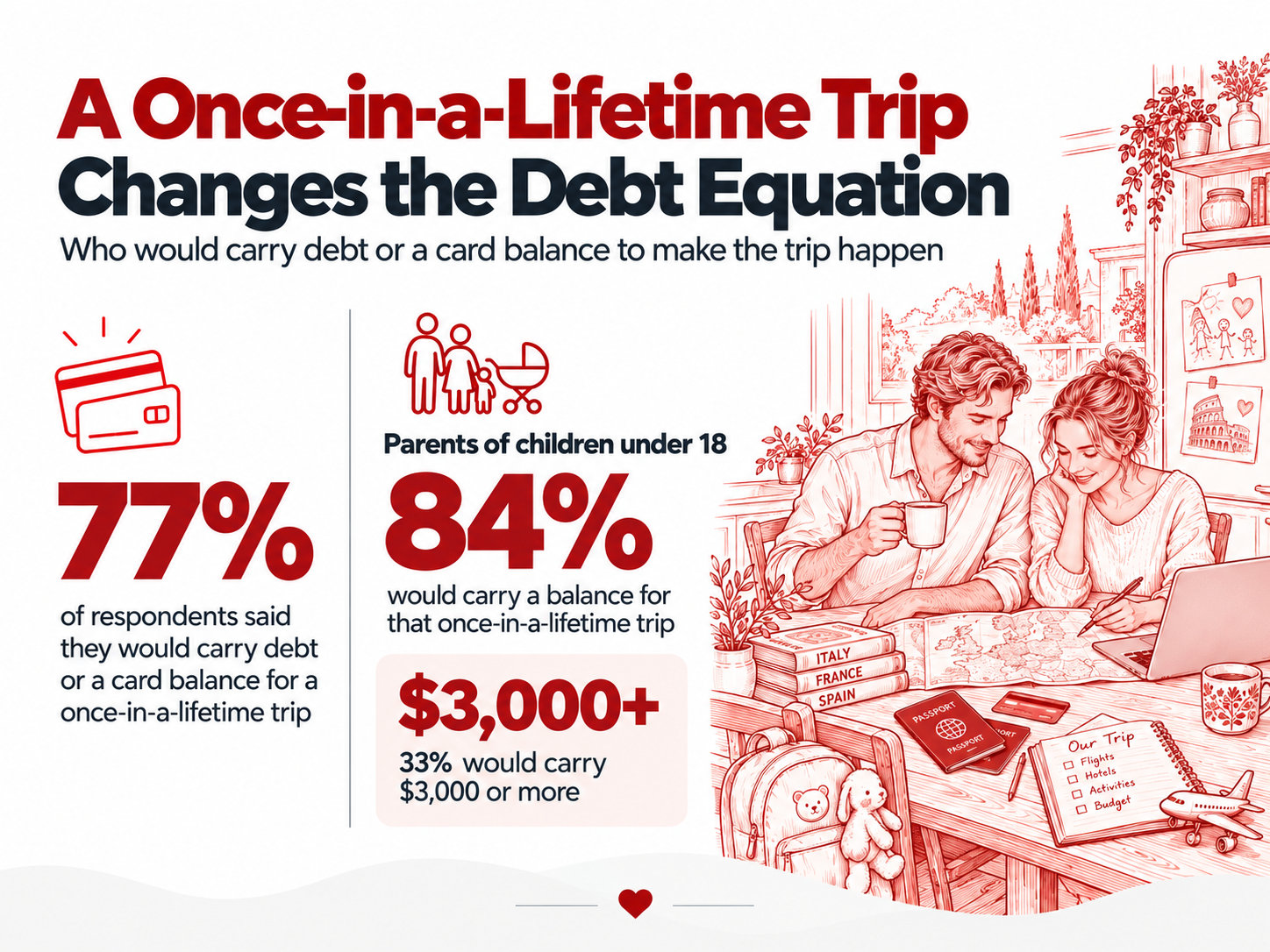
The headline number carries a condition worth repeating. The 77% who said they would carry debt or a card balance were answering about a trip they considered once-in-a-lifetime, and the amounts vary sharply by who is at home.
Parents of children under 18 were the most willing of any group large enough to report: 84% said they would carry a balance for that once-in-a-lifetime trip, and 33% would carry $3,000 or more.
Among travelers with no children at home, 72% would carry a balance and 19% would go past $3,000. The survey’s parental-status question allowed more than one answer, so the parent and no-children groups are not mutually exclusive.
Willingness to carry the larger balances was higher in middle- and upper-income households. 30% of respondents in households earning $50,000 to $99,999 and 29% of those earning $100,000 to $249,999 said they would carry $3,000 or more for a once-in-a-lifetime trip, compared with 20% of those earning under $25,000. Men were somewhat more willing than women to carry any balance at all, 81% to 75%.
Those balances would not be cheap to hold. The Federal Reserve’s most recent consumer credit release puts the average APR on credit card accounts assessed interest at 22.15% for the second quarter of 2026.
They Plan To Save First
The willingness to carry a balance sits next to some notably disciplined planning. 67% of respondents said they would start saving for the trip six months or more in advance, and 33% would start more than a year out. Only 5% said they would not save specifically for it at all.
Their spending expectations run modestly, too. 49% capped what they would realistically spend on a two-week trip at under $5,000 per person, and 81% capped it under $8,000.
Cost remains the thing most likely to stop them. 34% named total trip cost as the biggest obstacle in the next two years, and 18% pointed to economic uncertainty. That worry rises across the three largest age groups, from 9% of Gen Z to 16% of Millennials and 24% of Gen X.
Read together, the numbers describe a planned decision. These travelers said they would save early, set a ceiling, and protect the trip when circumstances push back.
What a Higher Price Actually Buys
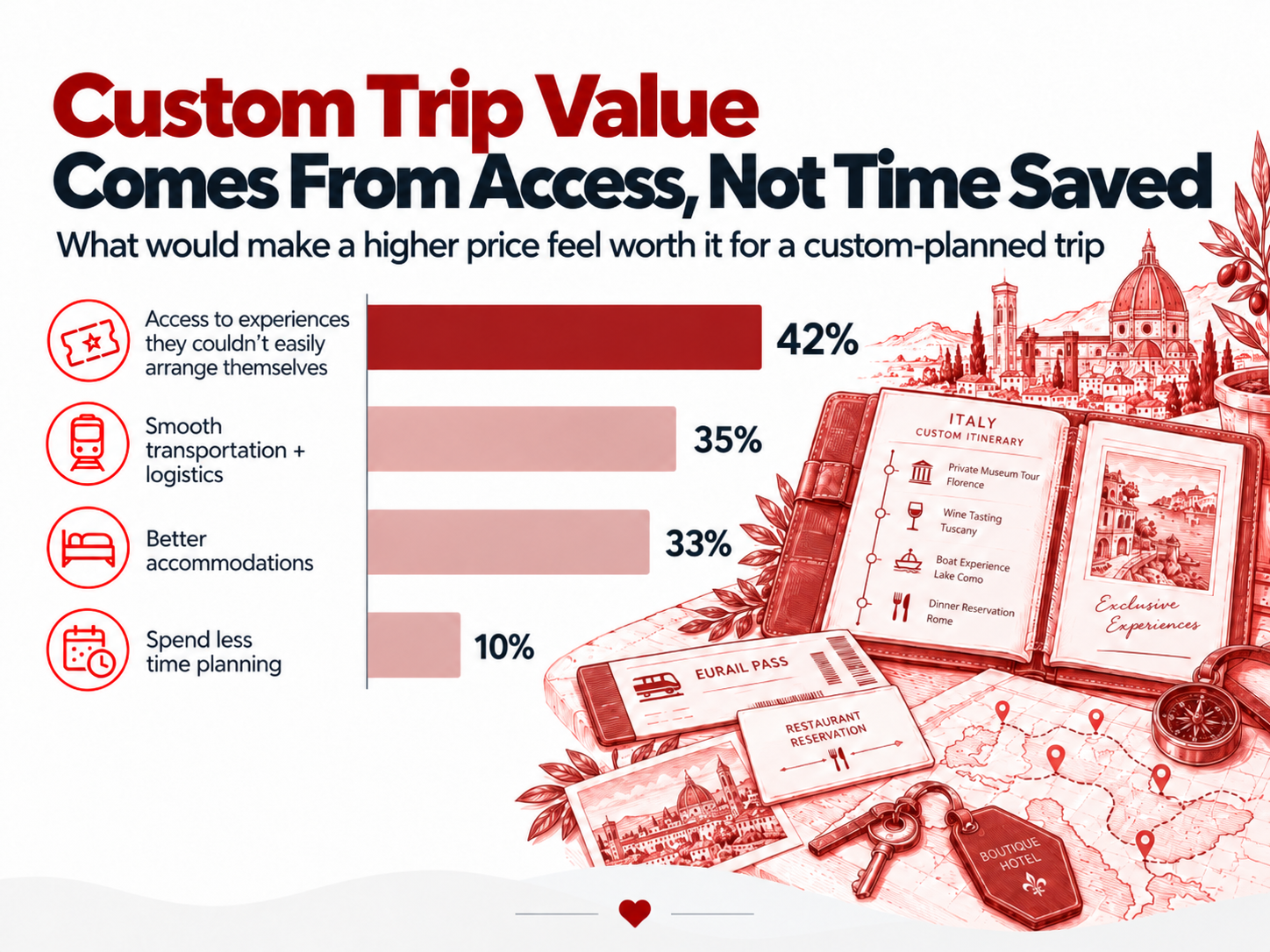
For an industry built on saving customers time, the survey has a twist. Asked what would make a higher price feel worth it for a custom-planned trip, respondents selected access to experiences they could not easily arrange on their own four times as often as spending less of their own time planning, 42% to 10%.
Smooth transportation and logistics (35%) and better accommodations (33%) also outranked the time savings.
And most would pay for it. 67% said they would pay at least some premium for a custom-planned European trip, and 42% would pay 6% or more on top of the trip cost.
Travelers who had been to Europe in the past five years were the most receptive, with more than three-quarters willing to pay a premium, compared with 61% of those planning a trip who had not visited in the past five years.
The pattern echoes the flight finding. Once travelers know what the trip demands, they appear to put money toward the parts they would rather hand off.
Strip away the percentages, and the survey describes a quiet reordering of what counts as essential. For these travelers, the trip stopped being the reward at the end of a well-managed year. It became the thing the year gets managed around.
Takeout, new clothes, even the home upgrade can wait. The trip itself cannot, and nearly 8 in 10 would find a way to keep them when fares spike.
Taken together, the answers sketch a traveler who plans early, sets a ceiling and treats the dates as fixed. When the budget tightens, the seat, the hotel and the restaurant absorb the hit before the calendar does. For a trip framed as once-in-a-lifetime, that order of operations seems to be the point.
Methodology
JayWay Travel surveyed 1,000 U.S. adults through Pollfish in September 2026. All respondents had traveled to Europe for leisure in the past five years (198), were seriously considering or planning a leisure trip to Europe within the next three years (637), or both (165).
Results reflect this group of travelers and should not be read as representative of all U.S. adults. Figures are unweighted and drawn from a non-probability online panel. Several questions allowed more than one answer, so percentages for those questions total more than 100.
Combined figures such as “77% would carry debt” sum the individual answer options shown in the survey. Demographic breakdowns are reported only for groups of at least 50 respondents.
Fair Use Policy
Users are welcome to utilize the insights and findings from this study for noncommercial purposes, such as academic research, educational presentations, and personal reference.
When referencing or citing this article, please ensure proper attribution to maintain the integrity of the research. Direct linking to this article is permissible, and access to the original source of information is encouraged.
For commercial use or publication purposes, including but not limited to media outlets, websites, and promotional materials, please contact the authors for permission and licensing details.
We appreciate your respect for intellectual property rights and adherence to ethical citation practices. Thank you for your interest in our research.

Born and raised in Athens, Maria’s passionate about travel and storytelling, a combination that makes her ideal for her role as our content manager.